- DogSpeak: Redefining Dog Training
- Posts
- What We Lose When We Only Focus on Results
What We Lose When We Only Focus on Results
Plus, Decoding Aggression and Reactivity Summit and LIVE Q&A Event!

Nikki Ivey
April 07, 2026
What We Lose When We Only Focus on Results
Every time the conversation turns to the harm of aversive tools and techniques, a predictable comment shows up:
“Show me your training videos.”
I’ve spent time sitting with that response, trying to understand what’s underneath it. And where I’ve landed is this:
It doesn’t feel like genuine curiosity about the dog or the process. It feels like people are watching, waiting—looking for the moment the trainer “gets it wrong.” And even when the work is thoughtful, intentional, and effective, there’s still a reason it won’t be enough… or why it’s wrong.
Because this isn’t really about the dog.
It’s about defending a belief system.
You’ll often hear, “It’s about the results.”
And honestly, that’s the part that should concern all of us.
When we become hyper-focused on the outcome, we stop asking the most important questions about the how. We stop paying attention to what the dog is actually experiencing in the process. We stop considering the nervous system, the emotional state, and the dog’s capacity to learn.
And when the “how” no longer matters, the dog is the one who pays the price.
You see it reflected in the promises:
“Your dog will be fully trained in two weeks.”
But that’s not how learning works. That’s not how the brain works. READ MORE!
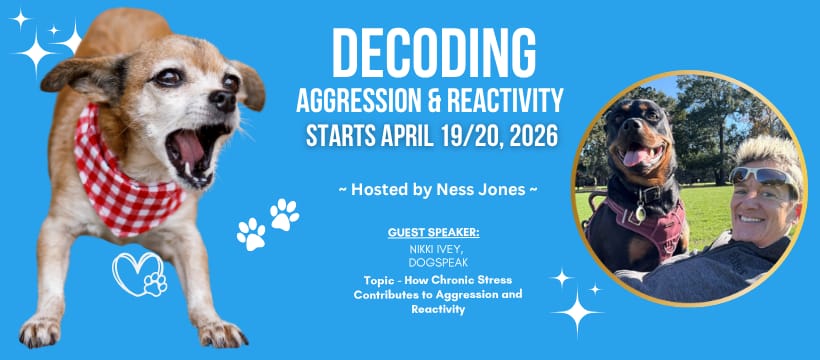
The speaker guest list on this masterclass event is epic. (Psssst. Just between you and I, some of these speakers are sought after worldwide to share their wisdom, but you can get it here when you sign up for 2026 Decoding Aggression & Reactivity Summit)
Register HERE!
Using Food as Reward or Bribery: A Fine Line
When using food or a toy as a reward you want to ensure that you don’t depend on it.
You should be like a slot machine and only pay out variably without the dog having to
see the reward. Let’s take a look at the difference.
Bribery occurs when you use the food or toy reward to entice your dog to exhibit a
particular behavior. Maybe you do it by showing your dog the reward and then asking for
a behavior or you ask for the behavior and when he doesn’t comply you show the reward.
You can also bribe your dog by shaking a treat bag or using words that signify a treat
such as, “do you want a cookie?”
Luring is also a form of bribery. This occurs when you use a treat for your dog to follow
in order to exhibit a behavior. When luring, it may seem like you are getting the behavior
faster but in reality, you are adding one more step to the process because you then have
to eliminate a behavior (the treat) before you are able to command the behavior without a
reward in sight.
The proper way to use any type of reward, regardless of if it’s food or a toy, is to get the
behavior first, acknowledge it with a verbal, and then give the reward. The reward may
be in your pocket, in a treat bag or even in a jar on the counter in another room. As a “slot
machine” you should keep your dog guessing as to when the payout will occur. He will
continue to offer the behavior hoping the next one hits the jackpot.
The most important thing to remember is to not depend on a food or toy reward. Focus on acknowledging behavior with a verbal, with a verbal and pet and then a verbal with a
resource. If you focus on always acknowledging what you want to see repeated, you are
more likely to have a consistently well-mannered dog even in the absence of a physical
reward.